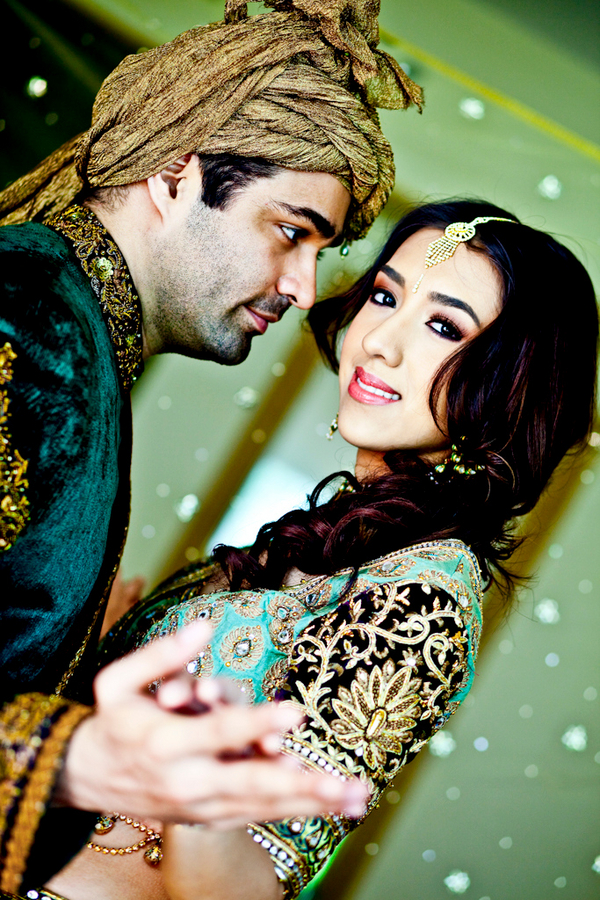
For #FashionFriday, today, in collaboration with Rani By Neha Mahajan, we bring you the latest trends in Indian Wedding Fashion for Fall 2011.
Anarkalis are still the craze: Anarkalis suits make a style statement and looks good on everyone! They were worn during the Mughal era and look regal and classy. The Anarkali cut compliments all body types and the kalis or panels of the Anarkali can be increased or decreased based on one’s style. Moreover, almost any neckline and sleeve length works with this style! This way you can make it as traditional and classy or sexy and modern as your want. An Anarkali makes for a great outfit for a Mehendi or a Sangeet.
In Style: Short ethnic vests are in style and can be used to dress up a Salwar Kameez or transform an old one into a stylish new one. Bonus Tip: You can even wear it over your LBD for an Indo-Western look!
This Anarkali, paired with a short ethnic vest, has a lovely crimson border and beautiful antique gold embroidery.
Welcome to #FashionFriday on Marigold Events! #FashionFriday posts feature Indian Fashion Designers, talking about how they got started in the industry, and their unique style. Continuing with our series of posts written by Gina Mathew, Founder of Couture Rani, today we will feature Indian Fashion Designer Tarun Tahiliani, and his claim to fame.
The Beginning
One of the undisputed greats of Indian fashion, designer Tarun Tahiliani began his career in management after earning a business degree from The Wharton School of the University of Pennsylvania. After returning to India, Tahiliani saw the potential of the evening wear and couture market and conceived of a fashion boutique to house the best design talents in India. In 1987 Tarun and his wife Sailaja Launched ‘Ensemble,’ the first of it’s kind multi-brand boutique in Mumbai. It was during this time that Tahiliani thought about launching his own design label. Although the designer had plenty of raw talent, he did not know how to sew or construct garments. In order to hone his technical knowledge and become proficient in these areas, he enrolled at the Fashion Institute of Technology in New York. Following his return to India from New York, Tahiliani founded his design studio and eponymous label in 1991 and set up base in New Delhi as he believed this was where fashion center would develop in India.
Welcome to #FashionFriday on Marigold Events! #FashionFriday posts feature Indian Fashion Designers, talking about how they got started in the industry, and their unique style. Continuing with our series of posts written by Gina Mathew, Founder of Couture Rani, today we will feature Indian Fashion Designer Gaurav Gupta, and his claim to fame.
Gaurav Gupta might not be the most talked about or well known among the Indian designers but his talent, design ingenuity and global outlook make him one of the few Indian designers poised for international success. Born and raised in New Delhi, Gupta was resolute in his decision to become a designer. Like many of his industry peers, he attended the National Institute of Fashion Technology in the capital city. He then furthered his design education by earning a degree from the prestigious Central St. Martins College of Art and Design in London from which he graduated with honors. While there, his graduate collection was awarded the Future of Couture trophy at Altaroma Altamoda, Rome Couture fashion week. He then went on to work with designers Hussein Chalayan and Stella McCartney before returning to India in 2006 to launch his own label.
Welcome to #FashionFriday on Marigold Events! #FashionFriday posts feature Indian Fashion Designers, talking about how they got started in the industry, and their unique style. Continuing with our series of posts written by Gina Mathew, Founder of Couture Rani, today we will feature Indian Fashion Designer Sabyasachi Mukherjee, and his claim to fame.
Designer Sabyasachi Mukherjee or better known simply as Sabyasachi is one of the few Indian designers who has gained international recognition for his work as well as a loyal fan following worldwide. Although, his design sensibility is firmly Indian, his unique combination of prints, textures, and colors cut in contemporary silhouettes have created an inimitable style and given his collections a truly global appeal. Sabyasachi graduated from the National Institute of Fashion Technology in Calcutta in 1999 and just four short months later launched his own label. In 2001, he won the Femina British Council’s Most Outstanding Young Designer of India Award, which took him to London for an internship with designer Georgina Von Etzdorf. The internship was a instrumental in helping the designer to broaden his world view and design sensibilities. Upon his return, Sabyasachi began retailing in all the major stores in India. In 2002, he participated in his first fashion week at Lakme Fashion Week where his debut collection earned him rave reviews from both the national and international press. Women’s Wear Daily, considered the most respected international trade magazine, called Sabyasachi the “future of Indian fashion.”
Welcome to #FashionFriday on Marigold Events! #FashionFriday posts feature Indian Fashion Designers, talking about how they got started in the industry, and their unique style. Continuing with our series of posts written by Gina Mathew, Founder of Couture Rani, today we will feature Indian Fashion Designer Duo, Shantanu and Nikhil, and their claim to fame.
The Beginning
Brothers Shantanu and Nikhil Mehra pursued divergent career paths until they decided to come together to form the Shantanu & Nikhil fashion brand. Nikhil pursued his Masters in Fashion from the Fashion Institute of Design & Merchandise (FIDM) in Los Angeles while Shantanu completed his MBA in finance from Ohio State University. Nikhil then worked for St. John, an upscale American fashion brand while Shantanu worked in the corporate finance division of General Motors. Shantanu observed the growth of the Indian fashion industry and decided to combine his business knowledge with Nikhil’s design talent to create something different for the Indian market. In 1999, they both returned to India to pursue their dream of launching a fashion brand. Of their partnership they’ve said, “We believe that we are the best combination of art and commerce in the creative world of fashion. This mindset is what prompted us to cross-synergize our respective backgrounds into something worthwhile that could withstand the pressures of the ever-challenging and the ever-evolving fashion industry”. Read more »
Welcome to #FashionFriday on Marigold Events! #FashionFriday posts feature an Indian Fashion Designer, talking about how they got started in the industry, and their unique style. Continuing with our series of posts written by Gina Mathew, Founder of Couture Rani, today we will feature Indian Fashion Designer Duo, Abu Jani and Sandeep Khosla, and their claim to fame.
Early Life
Abu Jani was born Mumbai in an affluent Muslim family. Like most creative individuals he knew from an early age that he wanted to be involved in an artistic career. He began his career working with Xerxes Bhartena, a costume designers for films where he worked for five years and assisted him in designing costumes for a number of films. This was followed by a job in a garment export house, where he gained experience in designing and embroidery. He then began working as a freelance designer and began making clothes for private clients. His popularity began to grow and just as he was deciding on whether or not to open his own boutique he met Sandeep Khosla.
Sandeep Khosla was born in from Kapurthala, Punjab. He was always drawn to the arts and while in school explored painting, drawing, carpentry, and batik designs. Early in his career he worked in his family’s leather business where he specialized in carving on leather and dying techniques. He then moved on to working in fabric exports where he learned about fabrics and garment manufacturing. He then moved to Mumbai where he joined designer Xerxes Bhartena and began learning the art of designing. He was the same designer who years earlier, had given Abu Jani his first break as a fashion designer.
The Beginning
A chance meeting in August of 1986 led to the creation of “Mata Hari” a clothing boutique in Juhu, Mumbai. They realized they has similar goals and dreams and set out together to fulfill it. Jani explains of their meeting: “We met at a mutual friend’s home and decided within 48 hours to go into partnership. We had no formal training in fashion and precious few resources. Our families lent us a couple of lakhs to put together a collection. And that was it.”
The Abu-Sandeep Woman
According to Abu Jani, “the Abu Sandeep Woman is her own person. She is discerning, au fait with luxe, a stylista rather than a fashion junkie. Classically elegant, exquisitely feminine, her clothes are a reflection of her. We design for ourselves but our muse is always a woman.”
Design Philosophy
“Be true to your own aesthetics. We do not design with commercial considerations, international trends or competitors in mind. We never compromise our sense of aesthetics or quality in order to make a profit or be in vogue. Set the bar; don’t try to clamber over an existing one.” -Anokhi Magazine (Nov. 2010)
Career Highlights
The Abu Jani and Sandeep Kohsla label were the first to retail internationally with a range of exclusive shawls for Harrods and Harvey Nichols in London and Neiman Marcus in the United States
Dressed Bond Girl Sophie Marceau in The World is Not Enough
Dressed Dame Judi Dench at six Oscar and BAFTA award ceremonies
Hosted their own talk show called “First Ladies” on NDTV
Won the National Award for designing the costumes for Madhuri Dixit and Shah Rukh Khan in the 2002 Hindi film Devdas
August 2011 marks the 25th anniversary of their design partnership
Welcome to #FashionFriday on Marigold Events! #FashionFriday posts feature an Indian Fashion Designer, talking about how they got started in the industry, and their unique style. Continuing with our series of posts written by Gina Mathew, Founder of Couture Rani, today we will feature Indian Fashion Designer, Suneet Varma, and his claim to fame.
Early Years
Suneet Varma was born into a family of bankers and lawyers but knew from a very young age that he wanted to pursue a career in the creative arts. He graduated from the London School of Fashion in 1986 and worked with Nicole Farhi in London and Yves Saint Laurent before launching his own label in India.
Design Aesthetic
Varma describes his style as elegant, glitzy, and super glamourous. His signature is his ability to create ensembles in silhouettes close to the body with minimal use of fabrics, although he loves to embellish his designs with appliques, sequins and crystals. In fact, his generous use of crystals on his garments led Swarovski to name Varma “the largest consumer of crystals in India in recent years”. Of this, Varma said, “If somebody wants shine and glamour and the innovative use of crystals, then they should come to me.”
An Indian Wedding Planning Checklist can be a really long one, especially if you are having a multiple day celebration. While it is imperative to be organized, it is also important to relax and keep your cool throughout the process. Brides can sometimes get overwhelmed with all the various details they have to handle in order to make their big day memorable: from venue, caterer, decor, cake, to invitations, bridal wear, and jewelry; throw in keeping up with the latest trends.
Image Copyright: Rani By Neha Mahajan
While your wedding planner can take care of your venue, caterer, decor, cake, photo, video, and day of coordination; how does one get her wedding shopping done? Should you go to India, or should you look for clothing and jewelry vendors locally? If shopping in India, It is overwhelming to get all the shopping done, while trying to maneuver through a new city, and especially if you do not have family in the city you are visiting.
EnterNeha Rani Mahajan. Neha offers a wonderful personal shopping experience to South Asians based abroad in Delhi, India. Born, and raised in Cherry Hill, NJ, Neha spent many summers in India while growing up. A graduate of Penn State, Neha moved to New Delhi in 2007 after getting married. She planned her own wedding in Delhi while she was in the US, and has many years of first hand experience shopping in India. Not only does she keep up with the latest trends, she also understands what an Indian American bride is looking for. She says, “When Indians from abroad come to Delhi, they have a long shopping list and a very limited time. Throw in the mix: haggling with the vendors, communicating in Hindi, and an unfamiliar Indian business culture. My goal is to give the South Asian brides abroad, a stress free, and relaxing shopping experience.”
Welcome to #FashionFriday on Marigold Events! Today we are continuing our series of posts written by Gina Mathew, Founder of Couture Rani. These posts feature an Indian Fashion Designer, talking about how they got started in the industry, and their unique style. This week’s Featured Fashion Designer is Manish Malhotra.
Early Years
Manish Malhotra’s entry into the Indian fashion industry was very different from those of his designer peers. Although interested in fashion from a young age, he didn’t learn his craft in school. In fact, he began his career on the other side of the fashion business, as a model while still a student in college in Mumbai. Following graduation, he put his modeling career aside to start working at a small fashion boutique where he learned all aspects of design, production, sales and the ins and outs of the fashion business. As a huge fan of Hindi films, Malhotra always had Bollywood ambitions and his dream was to one day design clothes for Bollywood movies. Read more »
When shopping for your wedding outfit, knowing your style, colors and budget is very helpful in making the right choices. That, along with the understanding of different fabrics and embroidery can help you make the best decision.
Shopping for your bridal outfit can often be the most frustrating, nerve wracking and emotional part of the wedding planning process. To help manage your sanity and budget, we are here to give some tips on what to do before you start shopping for your wedding outfits.
Welcome to #FashionFriday on Marigold Events! This summer we will bring a series of posts written by Gina Mathew, Founder of Couture Rani. These posts will feature an Indian Fashion Designer, talking about how they got started in the industry, and their unique style. This week’s Featured Fashion Designer is Rohit Bal.
With his tousled, blond hair and penchant for button down shirts and white blazers it would be easy to mistake designer Rohit Bal for a suave Italian expat. He is, however, one of the most formidable fashion talents in India.
Bal, who hails from Kashmir, was always interested in design and began his fashion career after earning a degree from the National Institute of Fashion Technology in New Delhi. Encouraged by his mentor, Rohit Khosla, Bal launched his label in 1990 with a traditional men’s wear line and then slowly, added a woman’s wear collection which now includes bridal, couture and ready-to-wear. As a designer, Bal is known for his meticulous attention to detail. His pieces are intricately crafted and often incorporates the traditional embroidery techniques and textiles of his native Kashmir. Bal refers to his style as ‘understated opulence’ and true to that aesthetic his designs are free of rhinestones, crystals, sequins and any other extraneous “filler” embellishments. He prefers instead, to experiment with textures, shapes and volume, elements which are most evident in his couture collections.
Welcome to #FashionFriday on Marigold Events! This summer we will bring a series of posts written by Gina Mathew, Founder of Couture Rani. These posts will feature an Indian Fashion Designer, talking about how they got started in the industry, and their unique style. This week’s Featured Fashion Designer is JJ Valaya.
If the maharajas of India were still ruling the country today, JJ Valaya would be their star couturier. His design aesthetic is regal, royal and so utterly decadent that anyone in possession of his clothes would feel like a modern day rani or rajah.
Royal India is a recurring theme in Valaya’s life and work. Maybe growing up amid the palaces and forts in the princely state of Jodhpur, Rajasthan had something to do with it. Or perhaps, he feels a sense of nostalgia for a time when clothes were not just utilitarian garments but rather the work of master weavers, artisans and skilled craftsman. Read more »
Welcome to #FashionFriday on Marigold Events! This summer we will bring a series of posts written by Gina Mathew, Founder of Couture Rani. These posts will feature an Indian Fashion Designer, talking about how they got started in the industry, and their unique style. This week’s Featured Fashion Designer is Ritu Kumar.
Given the breadth, depth and history of India’s crafts and textiles, it’s hard to imagine that India’s fashion industry, as it exists today, is only a little more than a decade old. But if there was a pioneer in this field who saw an opportunity to merge India’s unique design skills and textiles and turn it into a bona fide trade, it was Ritu Kumar.
Ritu Kumar's most recent Bridal Collection: Falaknuma showcased in February, 2011
Humble Beginnings
Her start in the industry was as humble as it was enterprising. Before she became known as one of India’s leading fashion designers, she began working in textile design setting up shop with four hand block printers in a small stall in Calcutta. At the time, hand block printing was a dying art, with many of its artisans out of work.
An Indian Designer Label is Born
It was the ‘60s and printed chiffon saris from European mills were all the rage but Ritu saw an opportunity to showcase Indian prints on the trendy fabric. Given her background in art history, Ritu spent almost two years researching the various methods of Indian hand block printing before launching a small collection of saris. The saris were a hit and thus a designer brand was born.
As her collection expanded to include other Indian garments, Ritu opened a small boutique in Delhi, establishing the first designer retail store in India. Although a formal fashion industry did not yet exist in the country, Ritu laid the ground work to establish fashion design as an independent trade apart from the mass produced, commercial apparel being churned out by the various factories and mills in India.
Ritu Kumar's Lengha with Zardozi embroidered paisley and floral designs with sequin embellishments
Ritu Kumar’s Style
Following her success with block printing, which continues to be an important element in her collections, Ritu turned her attention to the revival of India’s other vanishing arts like handloom and embroidery. Zardozi, a type of gold coil thread embroidery, had essentially disappeared as a trade before Ritu revitalized the craft and made it fashionable by using it in her designs. It’s impossible now to imagine a bridal sari or lehenga without various types of intricate zardozi work.
Imagine trying out Indian designer bridalwear, while hanging out with your girlfriend and sipping on a mimosa on a beautiful summer day at a luxury hotel in Manhattan. This past weekend, Exclusively.In brought this kind of luxurious and pampering wedding shopping experience to New York that no South Asian Bride would ever want to miss!
Black Velvet Saree with Kundan Work by Shyamal and Bhumika
Brides could try out and buy custom fitted made-to-order Sarees, Lenghas, and Anarkalis from the exclusive collections from designers such as Ritu Kumar, Shyamal and Bhumika, Payal Singhal, Satya Paul, Archana Kocchar and more. For Grooms, there was a very elegant collection of Sherwanis.